
Eric M. Schmid Jr. | Critique of Linguistic Reason: From the Analytic Tradition to a Homotopic Metatheory of Language
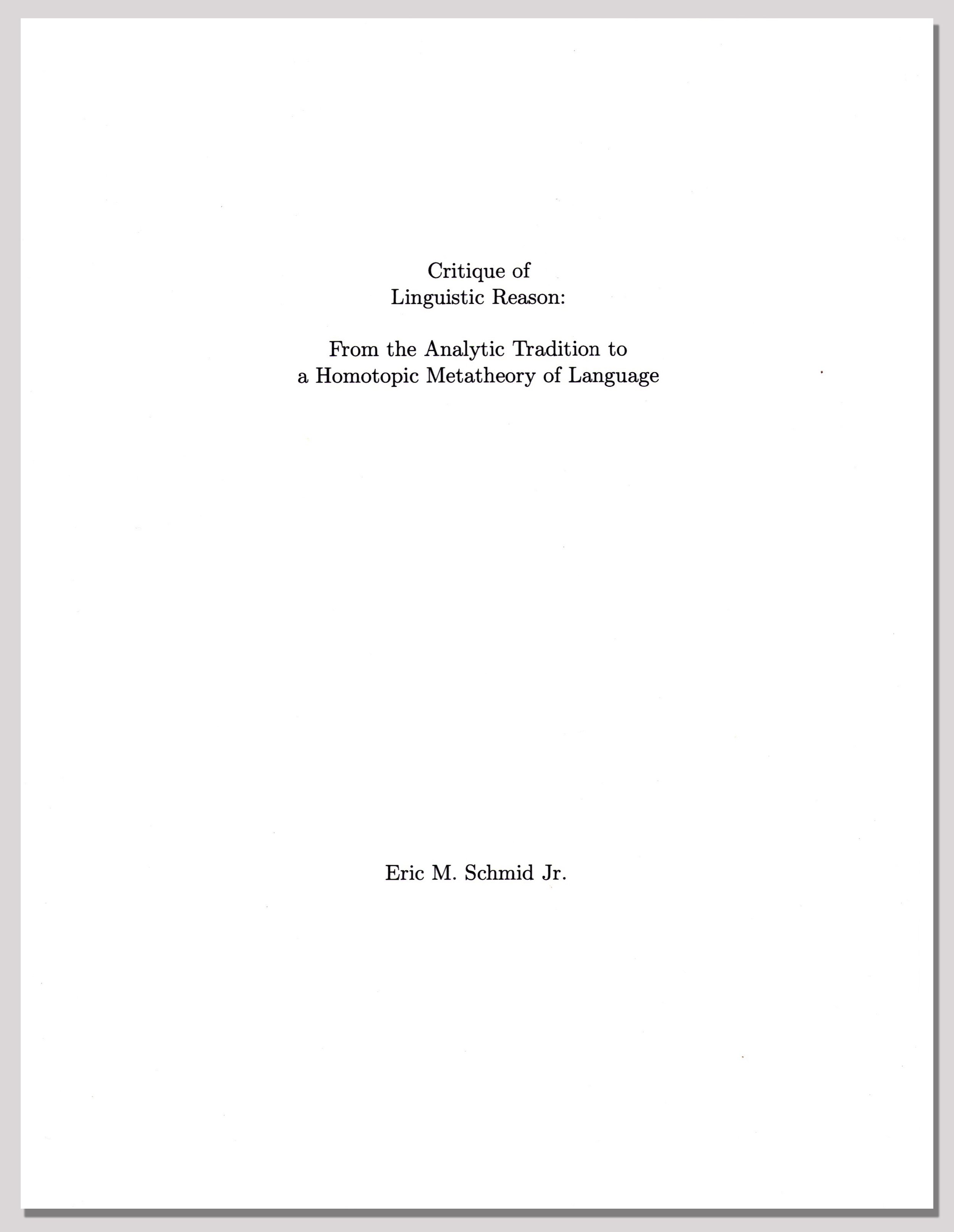
Eric M. Schmid Jr. | Critique of Linguistic Reason: From the Analytic Tradition to a Homotopic Metatheory of Language
Eric Makoto Schmid’s 4th philosophical treatise. 91 pages. Perfect bound.
About the text
“A critique, in the Kantian sense, is neither a refutation nor a foundation. It is a juridical proceeding: reason called before its own tribunal, required to exhibit the sources, the extent, and the limits of its claims. The first Critique asked how synthetic a priori judgments are possible, answered that they are possible as the forms of experience itself, and concluded that beyond experience they are impossible—the dialectic of pure reason being the record of what happens when the demand for the unconditioned outruns the conditions of givenness. Philosophy of language in the twentieth century staged the entire Kantian drama again without noticing. The analytic tradition began, at the height of neo-Kantianism, as a revolt against the "metaphysical bloatware"—Negarestani's phrase—of post-Hegelian speculation. Its instrument was the concept of analyticity: truth in virtue of meaning alone, deduction as tautology, mathematics as an immense system of dominos falling from definitions. Wittgenstein's Tractatus declared that all deductions are made a priori (5.133) and that where we cannot speak we must remain silent. Carnap radicalized the program: meaning itself was deracinated, replaced by syntax, and the choice among logical frameworks was declared a matter of tolerance rather than truth. Then the internal collapse: Tarski's undefinability theorem showed that every object language requires a metalanguage to define its truth predicate, and that metalanguage another, generating what Steve Awodey has called the ocean of metalanguages; Gödel showed that no sufficiently strong system totalizes its own consistency; Quine dissolved the analytic–synthetic distinction on which the whole edifice rested; and the synthetic a priori, three times expelled—by Russell, by the positivists, by Quine and Putnam—left behind a philosophy of language with no account of how meaning could be both objective and constituted. The present book contends that this history is not a sequence of accidents but a transcendental dialectic: the necessary fate of any philosophy of language that demands a global theory of meaning—a single semantic value function, a universal metalanguage, a view from nowhere above the fibres of use. The critique's positive task is to exhibit the conditions under which meaning is possible: inferential, interactional, type-theoretic, and fibered. Its negative task is to prove, with the resources of descent theory, that these conditions never yield a global section, and that the demand for one is the paralogism of semantic reason. Kant's three questions—What can I know? What ought I to do? What may I hope?—have linguistic counterparts, and they organize this book.” - Eric M. Schmid Jr.
Biography
Eric Makoto Schmid Jr. is a PhD student (Doktorand) in Theoretical Computer Science at the Eberhard Karls Universität Tübingen (University of Tübingen, DE). His intended research focuses on Induction-Recursion in Martin-Löf dependent type theory. He lives in Chicago. His hobby is writing philosophy books, which have been published by Bauer Verlag (Prolegomenon to a Treatise), Penultimate Press (Transcendental Mathematics), M. LeBlanc (Critique of Linguistic Reason) and Centralbanken (Critique of Transcendental Structure), as well as collecting kunstmusik.
Quisque iaculis facilisis lacinia. Mauris euismod pellentesque tellus sit amet mollis.